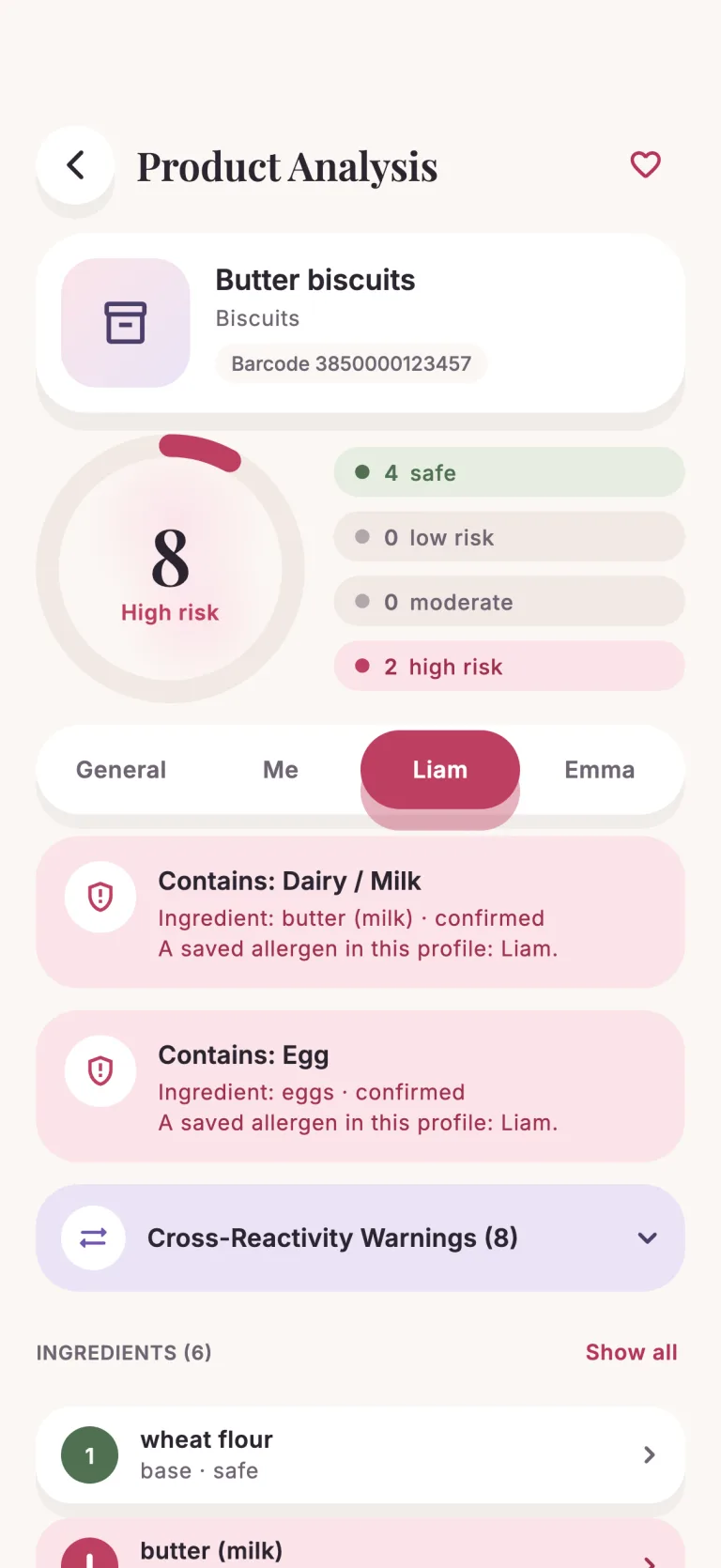
Food ingredient scanner: allergens, Red 40 and other food dyes, additives
Scan a box of crackers, a pouch of baby food or a granola bar and the scanner checks the ingredient list for the things parents ask about most.
- Allergens. The scanner checks the 14 allergens that EU law requires on food labels. Because that list includes sesame, it covers all 9 major food allergens in the US: milk, eggs, fish, crustacean shellfish, tree nuts, peanuts, wheat, soybeans and sesame. Allergens don't always appear under their plain name (whey and casein, for example, come from milk), so the scanner also knows more than 500 alternative ingredient names and warns about possible cross-reactivity.
- Food dyes. Colors are recognized whether the label uses the US name or the European E-number, so Red 40 and E129 are treated as the same dye. In the EU, foods that contain E129 or five other synthetic colors must carry a warning that they may have an adverse effect on activity and attention in children.
- Other additives. Additives such as titanium dioxide (E171) and the antioxidant BHT (E321) are matched across their US and EU names. Titanium dioxide has not been allowed as a food additive in the EU since 2022.
How allergen labeling differs between the two systems is explained in food allergen labels: US vs EU, and the additives parents ask about most are covered in food additives to avoid for kids.
Cosmetic and skincare ingredient checker: INCI names, EU restrictions, fragrance allergens
Cosmetics usually list their ingredients by INCI name (International Nomenclature of Cosmetic Ingredients), the standardized names you see on packaging in the US, the UK and the EU. Scan a lotion, shampoo, body wash or baby oil and the scanner compares each INCI name with the EU CosIng database of banned and restricted cosmetic ingredients under Regulation (EC) No 1223/2009.
Restricted doesn't mean dangerous. Many ingredients are allowed only up to a set concentration or only in certain types of products, so a flag is a reason to read the label more closely.
Fragrance is often listed as a single word, "fragrance" or "parfum", but some of its components are known allergens. In the EU, certain fragrance allergens must be named on the label above set levels. The scanner recognizes fragrance allergens such as limonene and linalool, and it reads ingredient names in several languages. The rules are explained in our fragrance allergens list.
Pregnancy-safe skincare checker: what the pregnancy profile does
Pregnancy is often when people first start reading skincare labels closely. Choose the pregnancy profile and the 0–100 score is adjusted for pregnancy, so the same face cream can score differently for you than for another adult in your family. Under the score you see which ingredients moved it, so you know what to look at instead of just a number.
The pregnancy profile applies to food as well: scan a snack or a drink and the result is adjusted for pregnancy in the same way.
The scanner doesn't decide what's safe for your pregnancy; it helps you read the label. Ask your OB-GYN, midwife or pharmacist about prescription skincare and anything you're unsure of. The ingredients that come up most often are covered in skincare ingredients to avoid during pregnancy.
Baby-safe products app: checking products for babies and toddlers
Babies and toddlers have separate profiles, because what suits a toddler isn't always right for a young baby. Scan a baby wash, a lotion, wipes or a snack and the score is adjusted for the child you've chosen. With family profiles each child can have their own, and your scan history keeps the products you've already checked.
Baby food with a barcode is scanned like any other food, so allergens and additives are checked the same way. If you cook for your little one, our baby and toddler recipes show which allergens each recipe contains.
Which skincare ingredients parents ask about most for babies is covered in baby skincare ingredients to avoid.
If your child reacts to a product with a rash, hives, swelling or vomiting, stop using it and call your pediatrician. Trouble breathing is an emergency: call 112 in the EU, 911 in the US or 999 in the UK.
Barcode scanner for ingredients: UPC and EAN, US and European products
The scanner reads the four common retail barcodes: UPC-A and UPC-E, used on products in the US, and EAN-13 and EAN-8, used in the UK, Europe and most other countries. It works for food, cosmetics and household products and detects the category on its own, so you don't have to choose.
Product data comes from open databases (Open Food Facts, Open Beauty Facts and Open Products Facts), a database of about 41,000 cosmetic products stored on your phone, and contributions from the community. When a product isn't found, take a photo of the ingredient list on the label and the ingredients are read from the photo.
What the scanner can't tell you, and where the data comes from
- It informs, it doesn't diagnose. The score sums up the ingredient list; it isn't a medical assessment. It doesn't replace your doctor, pediatrician or pharmacist, especially for allergies, eczema or medicines.
- Open data has gaps. Product information comes from open, community-maintained databases, and manufacturers change their products. A listing can be incomplete or out of date, so with a known allergy always read the label on the package in your hand.
- A flag isn't a verdict. A restricted cosmetic ingredient, an additive or a fragrance allergen is a reason to look closer, not proof that a product will cause harm. The amount, how the product is used and who uses it all matter.
- Rules differ between countries. Cosmetic ingredients are checked against EU rules. US rules for some ingredients and food dyes are different, so a product sold legally in the US can contain an ingredient that is restricted in the EU.